
Topic 4: Assessment & Training Evaluation
In this topic we will discuss the difference between assessment and evaluation, and reporting methods for each of the requirements.
This will be very useful for trainers looking to incorporate assessment and show the value of their training programme.
At the end of this topic, you will be able to:
- Determine level of assessment and evaluation requirements for stakeholders.
- Compare data storytelling objectives and strategies.
ISO defines learning assessment as, “Systematic method and procedure (i.e., test) for ascertaining work-related knowledge, skills, abilities or other characteristics or the performance of people or a group of people.”
On the other hand, training evaluation is defined as, “systematic process to determine the quality, effectiveness and impact of organisational learning and development provision.”
In short, assessment is to ensure that the learning objectives were achieved, and evaluation is to ensure the purpose of learning and development initiative was achieved.
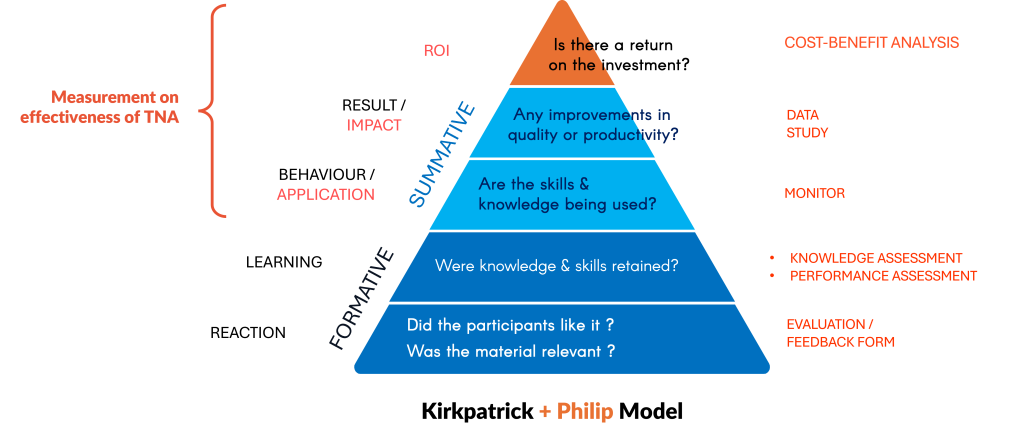
In essence, assessment answers the questions of:
- Did the participants learn what they were supposed to learn?
- Can they perform as required when they go back on the job?
This is done through knowledge assessment and / or performance assessment.
| Knowledge assessment | Multiple choice questions (MCQ) True or False / Matching quiz Short answer (e.g., fill in the blank) Essay |
| Performance assessment | Scenario-based testing / Sample benchmarking Performance checklist / scoring rubrics |
Whereas evaluation answers the questions of:
- Did the participants apply what they learned?
- Did the applied lessons impact improvements in the expected areas?
- Was the L&D initiative worth the investment?
Key considerations include:
- Opportunities to apply
- Support to apply
- Tangible improvements: Volume output, time / speed, quality, cost savings
- Intangible improvements: Level of service, work habits, work environment
Note:
The standard formula used to calculate this return on investment is:
Benefit-to-Cost Ratio (BCR) = Total Program Benefits ÷ Total Program Costs
if
BCR > 1: The financial benefits of the training outweigh the costs (a positive return).
BCR < 1: The costs of the training exceeded the quantifiable financial benefits.
Cost of training may include, but not limited to: Development fee, facilitation fee, purchase of resources, logstics, materials, and equipment purchased or rented.
Click on the question mark to see what type of data should we collect and review for each evaluation level.
Source of reference: Phillip’s ROI Methodology, ROI Institute.