
In this post, I would like to share the five (5) modules being used to conduct the Train The Trainer (PSMB Certified Trainer) training programme.
Please bear in mind that a trainer “must be PSMB TTT certified” (term set by HRDF) prior to conducting a training programme for clients contributing to the HRD Fund for their Malaysian employees.
Hence, the training topics, contents, training approach and targeted participants must be appropriate to the above condition. Topics such as motivation and team building are not a priority for PSMB, instead, they would prefer contributing companies to focus more on topics that can enhance their employees’ competencies which is in line with PSMB goal of having more skilled workforce in Malaysia. Therefore, please don’t get me wrong, if your training does not fall under this category; your targeted clients may be of a different market all together.

Module 1 – Plan Adult Learning.
This is the foundation of this whole training programme. If you are doing training and your target market is companies that contribute to HRDF, thus your participants will be from the professional working adults group.
These groups of participants will certainly have needs that are totally different from a group of entrepreneurs or unemployed graduates or even students.
However, the ability to handle this group of individuals will enable you to produce strategies for diverse levels of adult audience.
In this module, we will explore the differences between andragogy and pedagogy, different learning styles (including VARK, multiple intelligence, experiential learning, etc.) and how to adapt your teaching styles according to your audiences.
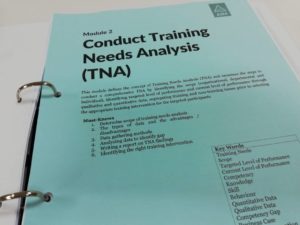
Module 2 – Conduct Training Needs Analysis
Training Needs Analysis (TNA) is a direct continuation of the Plan Adult Learning module. This is because, in the Plan Adult Learning module, we should already be aware that our training participants consists of professional working adults and they will only learn, listen or take note only if the training benefits them. Therefore, TNA must be carried out so that the training programme meets the requirements of the participants, and the organisation.
In short, if you want to teach people, you find out what they need to learn first.
If we fail to do TNA, we will face the risk of becoming a “self-absorbed trainer.” And this is what we want to avoid, especially when it comes to earning your training fees t HRDF (a public savings fund).
This TNA module provides basic exposure to the concept of obtaining genuine information and based on training requirements/needs – not because of ‘wants’ or because it has become a tradition to conduct the training. Training needs to be accurate and fills the competency gap between the current level of performance and the targeted level of performance of the participants. Training needs to be designed based on TNA and not “plucked from the sky”.
In this module, you will also realise and understand that training is not a magical solution that works for all employee performance problems. Some need non-training intervention as opposed to training as a solution.
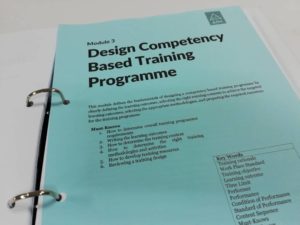
Module 3 – Design Competency Based Training Programme
Designing a competency-based training programme is very easy if we have conducted Training Needs Analysis (TNA).
How is this possible?
Once TNA is done, we only need to list down what the participants need to learn in order to close the competence gap between the current level of performance and the targeted level of performance – thus, this list becomes our training content.
In this module, you will learn the appropriate training methodologies to deliver training, what training resources need to be prepared and how to categorise them according to priorities so that the content can achieve the training objectives.
What’s important here is to understand what is behind the required PSMB template (for training claim process) while preparing the training programme outline.
This module is also an applied form of Plan Adult Learning (Module 1) as we need to apply the understanding of different learning styles and choosing a suitable training methodology to suit the audiences. Careful planning is also required to ensure effectiveness of training programmes. If you want to build your own module and create your own niche training programme, this knowledge is important to digest and understand thoroughly.
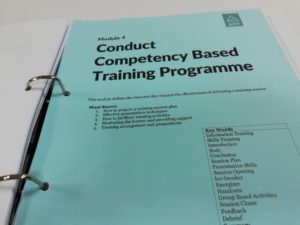
Module 4 – Conduct Competency Based Training Programme
This module emphasises on how to conduct competency-based training programmes. This means that the focus to enhance the competency of participants, NOT just motivation or just awareness or just communicating information. PSMB wants training conducted to be able to improve the ability of the employees that attend the training programme – that is worthy of the money that have been saved in the HRDF.
In this module, the ability to handle and conduct a competency-based programme is not limited to the trainer’s talent only. The understanding to be achieved through this module is that, if a trainer exercises certain techniques in his/her training sessions, participants will be able to increase their competency from attending the training session.
The emphasis is not on public speaking skills but more on skills to plan and execute the plan by diversifying your approaches with the understanding of the adult learning concept – think and do it with a purpose not just for fun.
What’s the difference about other trainings on this topic? (Public Speaking, Presentation skills, etc.)
The market may cover this topic in a more technical and in depths approach. Whilst in TTT programme, the objective is to understand and apply in the context of training – how it relates with designing training modules, training delivery and assessment of training effectiveness.
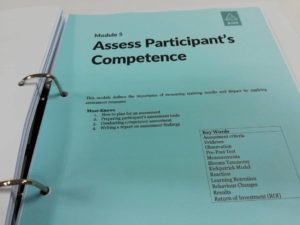
Module 5 – Assess Participant’s Competence
If you believe in the importance of the effectiveness of training programme that is being carried out, this will be an important module for you.
In this module, you will be introduced to the Kirkpatrick model, which is used to measure the effectiveness of a training programme. You will understand why the assessment form is necessary, why you must do a pre and post-training tests, how to prepare a checklist to measure behavior changes, and the impact from the training to the workplace after your training sessions.
You will go through a practical assessment session where your ability to conduct a training session (final assessment) will being evaluated based on the criteria listed in the Conduct Competency Based Training Programme (Module 4) which you have gone through, as well as to determine your comprehension and whether you have applied what you learned.
The entire TTT modules are related to one another and the learning process that you go through for five (5) days are simulations of knowledge, skills and attributes that are required to be a trainer.
This programme is essential as an introduction to the training world and personally, I think should be compulsory for trainers as well as those who are involved in the management and administration of training programmes.
The TTT certificate, a recognition by PSMB, is simply a “cherry on top” to what you take away from actually attending this training programme.
Build a solid foundation right from the start, and then seek additional knowledge to increase your competency as a trainer. From there on, you will be able to survive longer in this industry (insyaAllah).
#theIdeaSensei
#TrainTheTrainer
#PlanAdultLearning
#ProfessionalWorkingAdult
#TrainingNeedsAnalysis
#DesignCompetencyBasedTrainingProgramme
#ConductCompetencyBasedTrainingProgramme
#AssessParticipantsCompetence
#ApaAdaDalamTTT
#WhatsInTTT
#KnowYourAudience
#jagatrainingkenaadailmutraining
#DesignTrainingSendiriBukanBeliModulOrang
#JanganJadiTrainerSyokSendiri
#Certificate
#BelajarUntukIlmuBukanSijil
I am not positive the place you are getting your information, however great topic.
I must spend a while finding out more or understanding more.
Thanks for excellent information I was in search of this information for my mission. generic
viagra canada
I couldn’t refrain from commenting. Very well written!
I want to to thank you for this fantastic read!! I absolutely enjoyed every little bit of it.
I have got you book marked to look at new
stuff you post…
Thanks for the marvelous posting! I really enjoyed reading it, you are
a great author.I will remember to bookmark your blog and will
eventually come back later in life. I want to encourage you to continue your great work,
have a nice afternoon!
https://gumroad.com/mbaessaywritingservi/p/5-simple-steps-for-getting-a-analysis-paper-on-line
write papers for me
J, Vicky, https://gumroad.com/mbaessaywritingservi/p/5-simple-steps-for-getting-a-analysis-paper-on-line